


Our Living History
We are encouraged to listen to God speaking to us as He has spoken to his people in the past. By recovering the record of how, when, where, and to whom God spoke, we can recover meaningful instances of God’s action in the Church in the past, which in turn can be a resource in the present and for the future.
Writing a parish history is important because it allows our parish family to document and understand our past, connect with our heritage, provide context for the present, inspire future generations, and showcase the role the parish has played within the wider community over time; essentially serving as a record of our parish family’s faith, love and service through the years. When approached in this way our parish history can plant the seeds for future mission and growth.
Our parish’s 50th Anniversary celebration provided the perfect opportunity to prepare our parish history. Little did we know that it would also present a formidable challenge as over time, records and artifacts were lost or discarded due to water damage or neglect. While written records of baptisms, confirmations, marriages and deaths are required to be kept as mandated by Catholic canon law and remain intact, other resources were sparse.
At the outset knowing our intention in writing our parish history was important. Having a vision determined the sources we planned to use and hence the result we hoped to achieve. Our efforts were inspired by verses such as: “Great are the works of the Lord; they are pondered by all who delight in them.” (Psalm 111: 2).
We believe that our parish history should go beyond just dates and explore the social, cultural, and religious fabric of the community surrounding the parish, including details about the people who shaped it, significant events that impacted the congregation, changes in leadership, architectural developments of the church building, and how our parish adapted to societal shifts over time, all interwoven with the historical timeline. Our parish history is a holistic approach and includes histories of ministries and activities.
So where does one turn? Information was carefully gleaned from parish publications, programs, deeds, etc. With these resources we were able to reconstruct the early years of our parish history. To continue our parish history to the present day, we relied on parishioners who graciously shared their reflections. Parishioners past and present were invited to delve into their dusty attics and basements and digital devices for pictures, memories and artifacts. So, our parish history is not a typical chronological account, but more of a story of parish life which begins with our roots in a local Long Island community and continues with a compilation of many voices, those echoed from the past as well as the present.
We are indebted to all who contributed to our parish history! It is a living story with many chapters yet to be written. We wonder what they will say.
Our Roots
Scriptural background rootedness
The gospel of Mark begins in the desert with St. John the Baptist preaching to the multitudes and calling on them “to prepare the way of the Lord.” Mark writes that the Baptist stated that he must decrease, and Jesus must increase, for the Baptist was just a forerunner, preparing the way of the Lord. How like the history of our own growth as a parish community. We were, if you will, disciples of St. John the Baptist, in Wading River, and we were fed and instructed until one day, we heard ‘Behold, the Lamb of God,’ (John 1: 36) and like two of John’s disciples, we followed Jesus and spent the day with him. That day, back in 1973, has become fifty years, during which we have continuously answered the call, which our patron, St. Mark, noted in the longer ending to his gospel: “they went forth and preached everywhere, while the Lord worked with them and confirmed the word through accompanying signs.”
(Mark 16: 20)
The settlement, later called Wading River, began in 1671. There would be no Catholic parish in the area for more than two hundred years. The earliest Catholic parishes in the area were St. Patrick, Southold (1865); St. John the Evangelist, Riverhead (1869); St. Agnes, Greenport (1886); Sacred Heart, Cutchogue (1901); Infant Jesus, Port Jefferson and St. Isidore, Riverhead (1903) and St. John the Evangelist, Center Moriches (1904).
The Catholic population either traveled the distances to these churches or when permission was granted by the Bishop of Brooklyn, a traveling ‘circuit’ priest would celebrate mass in the home of a Catholic family in the area. In 1912, the Diocese of Brooklyn comprised all of Long Island until 1957 (Kings County, Queens County, Nassau County and Suffolk County), when it established a new parish, Sts. Peter and Paul in Manorville. The founding pastor was Fr. John Naab.
With this founding of a parish and a permanent priest, a summer resident of Wading River, Mrs. Mary A. Hurliman, offered her home for Mass to be celebrated there. For the next ten years, when Fr. Naab was able to make the journey, Mass was celebrated in her home on Sound Road. Mass was also celebrated in the original Greenbrier Inn’s dining room and the home of Theodora Heatley. In August of 1920, Mrs. Hurliman, donated land to the Diocese of Brooklyn on North Country Road in the hopes that the bishop might establish a parish there.
In 1915, Fr. Naab was transferred and Fr. Francis X. Wunsch was appointed pastor. He served the Wading River area for the next two years. In 1917 Fr. Wunsch was transferred and Fr. Henry A. Spengler was appointed as the third pastor, serving until his transfer in 1922.
In January of 1922, Fr. John Regulski was appointed pastor of Sts. Peter and Paul in Manorville. Sometime later, Bishop McDonnell of Brooklyn established the parish of St. John the Baptist in Wading River, on the land donated by Mrs. Mary A. Hurliman, and a small church was built there by the end of 1922. Fr. John Regulski is the Founding Pastor of St. John the Baptist Church in Wading River. In his tenure, 1922-1935, the church and rectory were built at Wading River, and he oversaw and served the “Missions” of St. John the Baptist: the parish of Sts. Peter and Paul in Manorville and a newly constructed ‘Chapel’ created on North Country Road in Shoreham. In 1957, when the Diocese of Rockville Centre was created by Pope Pius XII, Bishop Walter P. Kellenberg, the First Bishop of the new Diocese, officially designated both communities as “Missions” of St. John the Baptist.
On Our Own
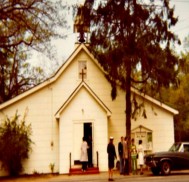 On September 26, 1973, Bishop Kellenberg officially ‘erected’/established the parish of St. Mark, whose boundaries, set by the Diocese, comprised the Incorporated Village of Shoreham, East Shoreham and parts of Ridge and Yaphank. (Shoreham and the adjoining hamlet of East Shoreham share a post office, which has 11786 as the zip code. Despite its official name, Shoreham is invariably referred to by its inhabitants as "Shoreham Village", while East Shoreham is called "Shoreham".)
We started in the ‘Mission Chapel’ that was on North Country Road and Randall Road, a former General Store. It was Fr. Raymond Tortora, who with the vision and sacrifice of the parishioners of St. Mark, started making plans in a few months to build a new church, that took over three years to build and in which we presently worship. It was dedicated on December 12, 1976 by Bishop McGann.
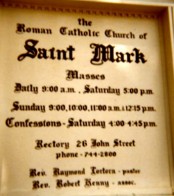 “Shoreham Village” is located on the scenic, wooded, hilly North Shore of Long Island, about 70 miles east of New York City. In the 19th Century, the site was known as "Woodville Landing," for the break in the bluffs where locally harvested cordwood was loaded upon flat-bottom boats for trans-shipment to New York and to the brick works at Haverstraw on the Hudson.
In 1900, its name was changed to "Wardenclyffe" by developer James Warden, who took advantage of the arrival of rail service in 1895, linking the area to Port Jefferson and New York City, to establish a summer resort and colony on the site. Warden also attracted inventor Nikola Tesla to establish his famous laboratory and radio tower nearby. Herbertt Hapgood took over development of the community upon Warden's death in 1906, and the community was renamed "Shoreham" by Elizabeth Upham, the spouse of one of Hapgood development partners Richard Upham.
Until the 1960's, Shoreham Village was a largely summer community but transitioned rapidly to a largely year-round community in the 1960's-1970's as its growth was spurred on by the arrival of local employment opportunities, including Brookhaven National Laboratory, Shoreham nuclear power plant and Grumman, as well as extension of the Long Island Expressway to Eastern Long Island.
“Shoreham Village” today, an area of about 280 acres, is vibrant and cohesive, with a strong community spirit and a tradition of volunteerism and of looking out for one's neighbors, as well as a deep devotion to the Village, its present and its future.
Villagers are very engaged in recreation, including seasonal water sports and tennis, to name a few, and have some well established celebrations and traditions, including joyous 4th of July festivities and an annual Labor Day Sunday tennis tournament with rival Wading River that has been played, without interruption, every year since 1924.
East Shoreham / “Shoreham” in 1901, Nikola Tesla built a laboratory and began constructing the Wardenclyffe Tower at Shoreham, with the intent of using it to wirelessly transmit communications and electricity. The tower was dismantled in 1917, and today a nearby static inverter plant receives electricity via the HVDC Cross Sound Cable. The nonprofit Tesla Science Center at Wardenclyffe is in the process of restoring Tesla's last remaining laboratory, building an educational center, and establishing a museum honoring his life and work on the property where the tower was once located. On November 21, 2023, a devastating fire erupted at the historic Tesla Science Center at Wardenclyffe. The Center is the last remaining laboratory of visionary inventor Nikola Tesla. More than 100 firefighters courageously fought the blaze, which caused serious damage to this one-of-a-kind treasure.
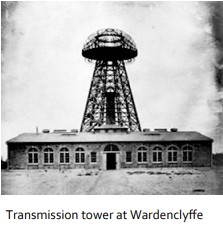 The transmission tower at Wardenclyffe was constructed during the period of 1901-1905. The Wardenclyffe facility was based on another of Tesla’s revolutionary ideas. Tesla planned to use the tower to achieve what the scientific community had so far considered impossible: a global, wireless communication system. The tower would be the prototype for a system that could broadcast music, news, stock market reports, secured military communications, even facsimile images around the world, using the Earth itself as a conductor. It was an incredibly prescient attempt to create a telecommunications infrastructure similar to what the Internet offers us today- but completely wireless.
But Tesla had an even more ambitious purpose in mind for the massive Wardenclyffe tower. He had already proved that high-frequency signals could be transmitted without wired connections using his own “Tesla coil” transformers, and this led to what would become a lifelong obsession: the wireless transmission of energy.
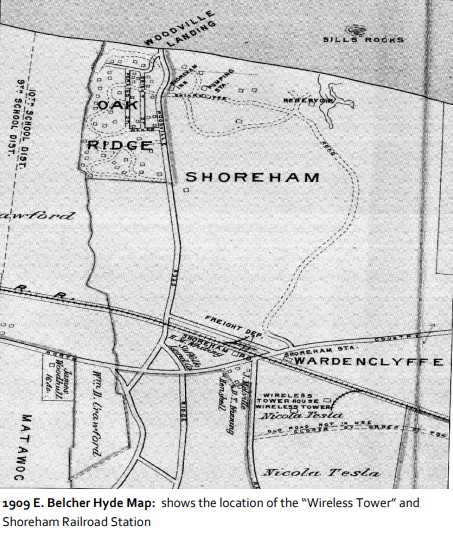 Tesla’s dream was to not only revolutionize telecommunications by creating a system for relaying information wirelessly, but also to create a viable method for transferring power currents around the globe by capturing the Earth's natural energy. Tesla saw that the world around us is brimming with “free” energy and was adamant about finding a way to harness it for the betterment of humanity. Secret experiments Tesla conducted at his Colorado Springs laboratory in 1899 had convinced him that it would be possible to transmit electrical power through the Earth’s upper atmosphere. Wardenclyffe was to be the prototype station for what he imagined as a grid of towers spanning the globe, realizing his dream of worldwide wireless power.
Tesla’s grand vision for Wardenclyffe exceeded his resources and his patrons’ patience. The project ran into financial difficulties before it was completed, and in 1917 the unfinished tower was finally demolished for scrap to satisfy Tesla’s debts. What had been a landmark laboratory full of fabulous Tesla inventions has now become a vacant testament to his most ambitious idea. Reference: Tesla Science Center at Wardenclyffe.
Shoreham was served by the Shoreham LIRR station from 1900 to 1910. It was located near the intersection of North Country Road and Randall Road. Since its early days, the population of East Shoreham has seen fluctuations. From a smaller community, it has grown to accommodate more residents, especially with the building of senior housing on Randall Road. These developments are Leisure Village, Leisure Glenn (The Glen), and Leisure Knolls.
This area is an ideal location on Long Island which provides residents with an unparalleled quality of life in a hamlet filled with culture. Nearby, homeowners can enjoy museums, shopping, dining, and popular attractions as well as great rated hospitals and relative closeness to New York City by car or LIRR and the East End of Long Island (North and South Forks).
Nature enthusiasts appreciate the many parks in the area such as Brookhaven State Park, Rocky Point State Pine Barrens Preserve, and Suffolk County Park. Residents also love the close proximity to several sandy beaches, Long Island wineries, country farms and nurseries, that provide fun for all the seasons throughout the area. The Leisure communities are active adult communities that are conveniently located near worldclass attractions.
Camp Upton and Brookhaven National Laboratory
Statement of Purpose … We advance fundamental research in nuclear and particle physics to gain a
deeper understanding of matter, energy, space, and time; apply photon sciences and nanomaterials
research to energy challenges of critical importance to the nation; and perform cross-disciplinary
research on computation, sustainable energy, national security, and Earth’s ecosystems.
Brookhaven National Laboratory
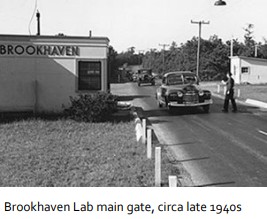
Brookhaven National Laboratory was established in 1947 on the eastern end of Long Island at the former site of the U.S. Army’s Camp Upton. The land presently occupied by the Brookhaven National Laboratory, once served as the site of the U.S. Army's Camp Upton, was active from 1917 until 1920, and again from 1940 until 1946. During both world wars, Camp Upton helped train new soldiers and prepare them for campaigns overseas. The Army was later to use the site as a convalescent and rehabilitation hospital for wounded veterans returning after World War II.
 Originally built out of a post-World War II desire to explore the peaceful applications of atomic energy, the Laboratory now has a broader mission.
Brookhaven Lab opened in 1947 with a post-World War II desire to explore peaceful applications for atomic energy. Visionary scientists began their work at groundbreaking science facilities, including the world's first nuclear reactor for peacetime research and new particle accelerators. Scientists at Brookhaven have discovered subatomic particles, new forms of matter, and pioneered technology that fuels leading experimental programs around the world.
Its research has also led to life-saving medical imaging techniques that have revolutionized diagnosis and treatment of disease. Brookhaven Lab is home to Seven Nobel Prizes, as well as scientists recognized with National Medals of Science, Enrico Fermi Awards, Wolf Foundation Prizes, 36 R&D 100 awards (the "Oscars of Innovation"), and many other recognitions.
Camp Upton and World War I
 When the United States entered the First World War in 1917, a standing army was non-existent, and large forces would be needed to fight overseas. It was decided that sixteen cantonments would be erected across the country to train the New York area inductees. The proposed army base was to be named Camp Upton, after Civil War figure Major General Emery Upton, who wrote many books on military policies.
Construction began in the summer of 1917, under the command of Major (OK) Meyers, construction quartermaster. A railroad spur was built specifically to unite Upton to the Long Island Railroad, and fifty-five railroad cars of supplies were unloaded daily. Thousands of tons of lumber, nails, and stone arrived at the construction site. When the first 2,000 drafted men arrived on September 10th, two-thirds of the camp had yet to be completed. The new soldiers were put side by side with the laborers to help complete the camp. On December 20th, the camp was officially declared complete, and turned over to Camp Commander, Major General J. Franklin Bell.
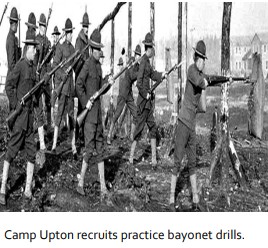
 In October, Major General Bell put into action a sixteen-week training program, which included almost every aspect of infantry combat. French and British officers were brought to the U.S. and instructed the men in tank, trench, and gas warfare. The draftees trained in the use of hand grenades and machine guns, and professional boxers taught the men hand-to-hand combat.
From these raw recruits came the nucleus of the 77th Division. Officially formed before the first draftee arrived in camp, the 77th was to gain recognition for its valor at the Argonne Forest in August of 1918.
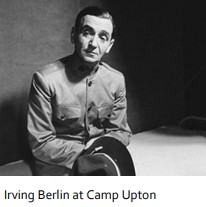
Among the members of the 77th was one individual who was already famous, and whose fame would grow after the war: Sergeant Irving Berlin. While at Upton, Berlin wrote "Yip, Yip Yaphank," a military musical based on his life at the camp. The show was produced on Broadway, with Berlin's fellow soldiers filling the cast. From this show came one of Berlin's most famous songs, "Oh, How I Hate to Get Up in the Morning."
Camp Upton and World War II *
With the war's end in November of 1918, Upton's use was limited. The camp served as a demobilization site for returning veterans, but the Army soon decided that Camp Upton was of no further use, and it was deactivated. At a public auction everything from the camp, from stoves to entire buildings, were sold. Some of the buildings sold at auction were converted into homes that still exist. For almost twenty years, the site remained quiet as Upton National Forest. Then, in 1940, the Yaphank wilderness came to life again as the war in Europe and in the Pacific (of which America was not yet a part) gave rise to a drive for military preparation. Since the Yaphank land was still available, the decision was made to rebuild the camp. Once again, plans were drawn up for parade grounds, barracks, and other support facilities necessary for ‘basic training’ of American troops.
Once Peace was declared in the European Theater and the war effort moved from to the Pacific Theater, the induction center was moved to Fort Dix, in New Jersey. The camp was then converted and expanded into a convalescent and rehabilitation hospital in September of 1944. Bowling alleys, swimming pools, and tennis courts were added to serve as recreational therapy for the patients. Camp Upton became a showcase for the type of treatment the returning wounded veterans would receive.
The camp was again deemed unnecessary once combat in the Pacific ended, drawing a close to the Second World War. Upton was officially declared surplus on June 30, 1945. However, this time the base was not dismantled. Several suggestions arose as to how the base and its facilities could be put to the best use, among them a plan to use Upton as a vocational school for the youth of Long Island. The final accepted proposal, however, called for the former Army camp to be converted into a research center for the peaceful uses of atomic energy. Barracks were to house the equipment to be used by the scientists.
In January 1947, Camp Upton had finally completed its service to the nation and Brookhaven National Laboratory was born.
*Some content in this section was taken from an article printed in “Our Voices.”
Fun Fact
Which is the oldest building in our parish?
The Joshiah Woodhull House is a historic building. Built circa 1720
by the son of Richard Woohhull, the founder of Brookhaven Town.
Located on the border of East Shoreham and Wading River, it is
the oldest standing building in the area.
Our Own Worship Space
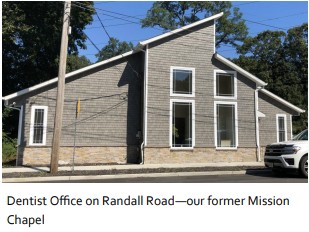
From its establishment in 1973 until the new church was completed in 1976, the parish worshipped in a small chapel on North Country Road in Shoreham, which barely held 100 people; the building was formerly a Country Store and is presently a dental office.
Our first pastor was Reverend Raymond Tortora, who in 1976 built the structure in which we now worship at 105 Randall Road. It served as both Church and parish center. It was a memorable autumn day in 1976 when parishioners processed a mile south from their small church to their newly completed church, holding 485 people, and parish center on Randall Road. The church was formally dedicated by Bishop John R. McGann, the Second Ordinary of the Diocese of Rockville Centre, on December 12, 1976.
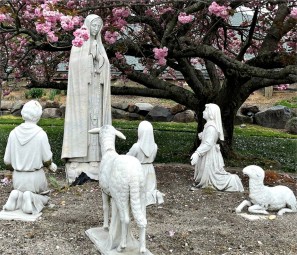 One of the other lasting gifts that Fr. Basel gave to the parish was the Lady of Fatima statue. It was noted in an Our Voices March 1992 article by Betty McAvoy, that …
Father Basel, our deceased second pastor, had said that if he became a pastor one of his first actions would be to honor the Blessed Mother with a statue of her apparition at Fatima. I, too, have a vested interest, as the very stones under the statue are those carried home from Fatima on one of my trips there. The children, the Angel Michael, and Our Lady walked where I gathered these special relics.
These are the names of those who donated the group statues: Barbara Reheiser (d) gave Our Lady; Grace Davis, Jacinta; Frances Maella (d) Francesco; Lucia, Virginia & Ed Naylor, the ewe; Margie Schemitat and Madeline Jones, the baby lamb.
In the late 1970’s and 1980’s the Catholic population was growing with the building of the three Leisure Housing developments of single unattached homes, attached condos, etc., for the 55+ age demographic as well as the expanding of mission and size of the Brookhaven National Laboratory, Stony Brook University Hospital, and Stony Brook University.
Leisure Village comprises 1,500 attached condominiums spread across 246 acres and was started in the late 1960’s for the 55 and over demographic. Leisure Knoll also a 55 and over community located in Ridge, New York, was started in 1972; it is a not for-profit Home Owners Association with 701 singlefamily ranch-style homes. Leisure Glen is a 100+ acre complex comprised of both single-family and semiattached dwellings; it was started over 30 years ago. At the same time younger Catholics with children were moving into new houses that were being built in the area. Fr. Ted Howard was faced with the need to expand the existing church / parish center facility, to meet the parish’s continued growth.
Thus, Fr. Ted Howard, our third pastor, redesigned the floorplan of the church, expanding it by removing the parish hall and pushing back the sanctuary. The newly enlarged worship space, capable of holding 800 people, was rededicated by Bishop William F. Murphy, the fourth Bishop of the Diocese of Rockville Centre, on September 29, 2002. Fr. ‘Ted’ also built the present Parish Center, which was equipped with a hall, kitchen and classrooms as well as a large meeting space, that can be divided with soundproof partitions so various groups can meet at the same time. The two are connected by a lobby area, allowing people to move easily from mass to the center for events.
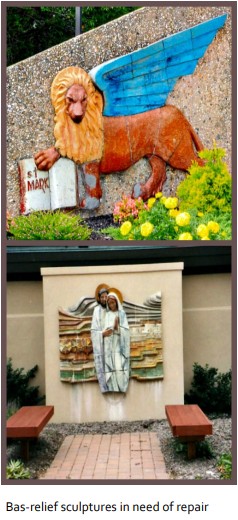 From an article in Our Voices by Rosemary Giuliano dated, February of 1995, the bas-relief of the two lions as well as the one of Joseph and Mary near the entrance doors to the church, and other pieces from the original church now missing, were designed by Raventos International of Barcelona, Spain.
The lions were always on the outside of the main entrance doorways, but the statue of Joseph and Mary was originally in the interior of the church, on the wall corresponding to the placement of the Baptistry.
Bas-relief is a French term from the Italian basso-relievo ("low relief"), bas-relief (pronounced "bah ree·leef") is a sculptural technique, in which figures and/or other design elements are just barely more prominent than the (overall flat) background. Bas-relief is only one form of relief sculpture: figures created in high relief appear to be more than halfway raised from their background. Bas-relief is created either by carving away material (wood, stone, ivory, jade, etc.) or by adding material to the top of an otherwise smooth surface (say, strips of clay to stone).
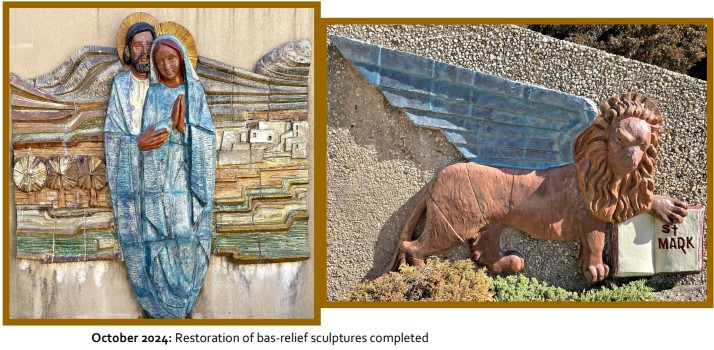
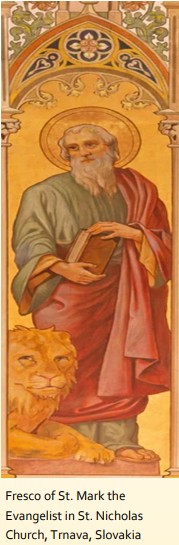
The bas-relief of the lions is in the traditional depiction of St. Mark as an Evangelist, writer of a gospel, as his gospel opens with the recounting of John the Baptist appearing in the desert. The bas-relief of Joseph and Mary have both figures in a unified single composition in an oval shape, where Joseph merges into Mary, as he takes the arm of Mary in a gesture of affection and protection while Mary turns towards him with her hands joined and her head gently tilted into his chest. Behind them are depicted the hills and the city of Jerusalem. With the renovation of the church, this bas-relief was moved to its present location on the outside wall by the newly created breezeway lobby, when Fr. Ted Howard built the Parish Center and enlarged the church interior space.
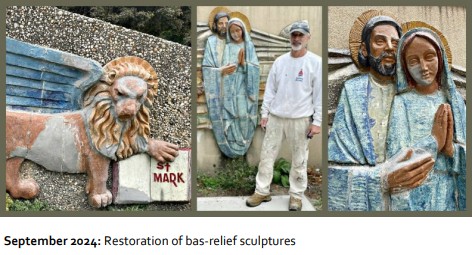 All three bas-reliefs had undergone serious deterioration over the years with exposure to the elements and one could see pieces were missing or the attempts of well-intended, but inappropriate repair. A letter was sent to the Barcelona Museum of Contemporary Art in the hopes of locating the artist, José Maria Gual, to ascertain the proper way of preserving and restoring these pieces of art. As there was no response to the parish’s inquiry, an inquiry was made to the company that was repairing and painting the interior ceiling of the church after the parish replaced the roof, to prevent further water leakage from further damaging the structural integrity of the church structure. The company was All Pro Painting and Improvement, Inc., which had a division that did restoration work on church statuary and historical artifacts. One of their artists worked on the pieces for two weeks repairing, repainting, sealing and water-proofing them so that we might have them for the future generations of St. Mark’s parish to enjoy.
 Peace Pole
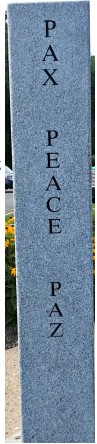
In memory of my parents and grandparents I am donating and installing a granite Peace Pole to be placed in Our Lady of Fatima’s grotto. In her apparition to the three children in 1917, Mary called us to pray for Peace in our world to end wars and the spread of Communism or, in the language of Pope Saint John Paul II, “the culture of death.” Having visited Fatima, I was struck by our Lady’s message and plea for Peace via the recitation of the rosary. Equally, experiencing the power of the “the culture of death” in our culture and world society and being aware of the global unrest at this time, her call to Peace is ever more needed to be heeded.
Hence, this granite Peace Pole. Originally, I commissioned one like this for Mary’s Garden when I was pastor of St. James parish in Setauket and have asked the stone engraver to create the same for St. Mark. It has the simple one-word message of Peace, written in various languages, including Latin, Greek, Arabic, Hebrew, English, Spanish, Celtic, Italian, German, Polish and Tagalog. I hope it becomes a cherished part of St. Mark’s living history, a statement of our commitment to the work of Peace and Justice in the local and world community of peoples. As a Catholic Christian, I hope and pray that Mary, the Queen of Peace, lead us to the Prince of Peace and the prayer of Peace - the rosary as a sacramental tool to foster within those who look at this Peace Pole, the works that reveal our love for God above all through our love of the one who is our neighbor.
Our Own Words
The first set of bound bulletins in our archives is from 1978. The bulletins were printed on legal size paper (8x11½), printed and folded in-house. April 2, 1978, saw the first outside printed and stapled bulletin, as we presently have. One of the regular features in the bulletin, under Fr. Ted, was a monthly insert / publication called The Word in the Home, published by the bulletin company, J.S. Paluch Company.
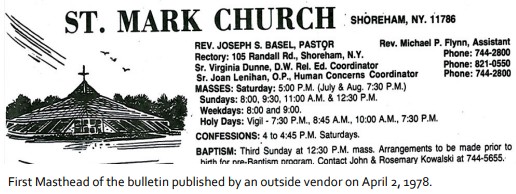
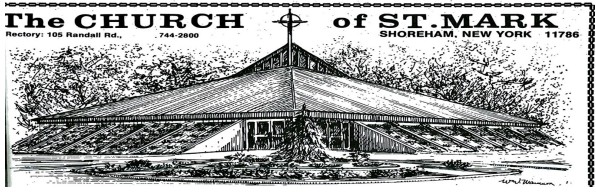
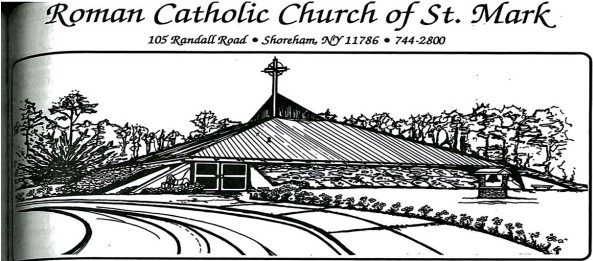
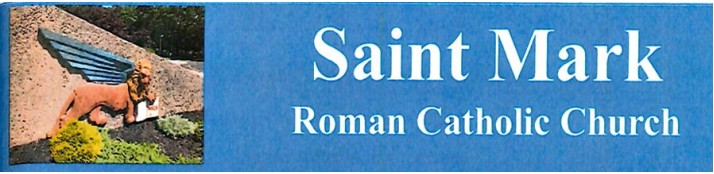
Following are images of the progression of our bulletin mastheads through the years.
Fun Fact
The Easter bulletin of March 26, 1978, had an article by then pastor, Fr. Basel, that the following
week, April 2, 1978, would have the weekly bulletin printed in the format that we presently have. (It was
four pages - can you believe that considering the current pages in our bulletin of 2024?)
Our Voices
“… ‘Ephphatha’, that is, ‘Be Opened’.” MK 8:35
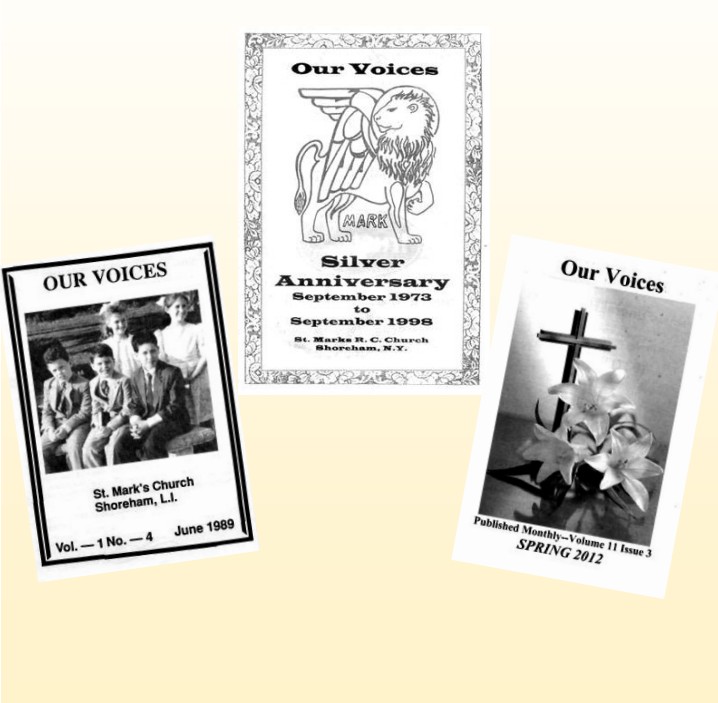
A monthly publication Our Voices was initiated in 1989 to assist parishioners in being aware of all the parish activities and various ministry groups. The parish has an incomplete set of issues from March 1989 to Spring 2012. The parish also has bound copies from 2000 to 2011.
In the words of Gus Lockwood, the initial editor, Our Voices is a monthly publication of St. Mark’s parish which has been distributed to each registered parishioner since March, 1989. From the beginning, Father Ted has insisted the goal of the publication must be communication. ‘I want to communicate with the Parish,’ he said. ‘I want the parish to communicate with me, the pastoral staff, with each other. That is the mission of Our Voices.’” “We have charted the growth of our RAP and ACTS groups from their tentative beginings (sic) to their present solid place in our congregation. We have described the Christmas and Easter tradition here and abroad. We have begun an explanatory series of articles about the Mass. We encourage Eucharistic ministers, lectors, ushers, CCD teachers, RAP and ACTs leaders to explain why they volunteered and what they get from their ministry. We take pictures in CCD classes, at baptisms, at First Communions, at meetings of parish organizations. We print the banes of parish newcomers and the newly married. We list the babies who have been baptized and we record the names of the deceased….And, each month in Our Voices the staff attempts to write its own Acts of the Apostles, the Acts of the parishioners of St. Mark’s. (August Lockwood, Our Voices, 6/94)
After Gus died, Fr. Ted Howard reminisced, Gus Lockwood shared my dream of a parish monthly. We chose the name Our Voices, which indicate that parishioners would be invited to write about their lives and the lives of other parishioners. I said, ‘There is so much of God’s work going on at St. Mark’s each day our people will never fully realize this unless we have parish monthly to share the good news of love and service.’ I felt that Our Voces could become a modern version of the Acts of the Apostles, that a book of the Bible that recorded the early life or our beloved Church. Gus agreed with my vision and so began the publication of Our Voices. (Father Ted, Our Voices, 10/97)
A Personal Commentary by Fr. Jim … this publication was one that chronicled the life and spirit of St. Mark’s parish under Fr. Ted Howard. It seemed to me, as I went through each issue, to be in the parish’s ‘hay-day’ of growth with new families coming into the parish area. In the light of a sparse four (4) page bulletin, it seemed to be the vehicle for reporting all the events of parish life.
It had a monthly listing of all newly baptized, married, newly enrolled parishioners as well as those that died in the previous month. It was in Our Voices, that I read about the coming and goings of Staff members, which the bulletin never mentioned.
The gift of Our Voices was that it truly offered and provided a venue to the voices of the parishioners, who shared poetry, stories, reflections as well as reporting the many and diverse activities of the parish during Fr. Ted’s tenure. Some of the features of each monthly edition included a column by Fr. Ted and his associate priest, as well as articles written by the various staff members and ministry heads. These articles covered Ushers, Altar Servers, Scouts, EM’s, Legion of Mary, Catholic Daughters, Third Order Lay Carmelites, Knights of Columbus, RAP, ACTS, Baptism Prep, Pre-Cana, Outreach, Ministry of Praise, PB & J Gang. It offered prose and pictorial coverage of the Christmas Pageant, Italian Nite, Pancake Breakfast, Mardi Gras, the summer Parish Picnic, First Communion Breakfast, Hospitality Sunday. It also reported on the extensive parish sports teams / programs that were sponsored by the parish, in addition to outings to Duck Games, altar server pool parties, etc. Two constants in its coverage were the Annual Parish Golf Outing, always with Fr. Ted amid the action, and Fr. Ted sharing his challenges with his health issues.
In my superficial perusal of the limited bound collection of Our Voices that the parish has, I was struck by the aliveness of the parish, the ‘esprit de corps’ that was manifested on every page of the issues throughout the years. I must say that in a way, I was jealous of what was but happy to see a rebirth of the same presently. May the parish never lose the gift of its Voice. Pax et Bonum.
The Little Mission Chapel
Shared by Bonnie Kisiel
As we celebrate our golden anniversary as a parish, we are fortunate to have many “charter” members available to share their memories of the creation and development of our beloved parish. In addition, Our Voices (published monthly by St. Mark’s from 1989-2012) provides a treasure trove of written memories penned by parishioners over the years. Below is a compilation of their recollections.
In the Beginning ...
 The story of St. Mark’s Parish started over 100 years ago. One of the goals of the newly ordained Bishop McDonnell was to establish a parish at every community on the Long Island Railroad. In June of 1912 he established the parish of St. Peter and Paul in Manorville, right next to the train station. In 1922, Father John Regulski was assigned as pastor, but promptly moved out of Manorville and took up residence in St John’s Mission in Wading River (Msgr. John Fagan, Our Voices, 10/98.)
Later that same year, Bishop McDonnell established the Parish of St. John the Baptist in Wading River, with Father Regulski as the founding pastor. During his tenure, 1922-1935, St. John’s Church and Rectory were built, and he oversaw the two “Missions” of Saints Peter and Paul in Manorville and the chapel in Shoreham.
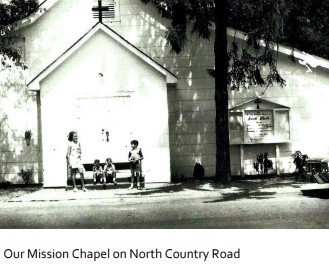
This little mission chapel, now a dentist’s office located at 47 North Country Road, has an interesting history. The building was originally a general store, which was run by Margaret Brennan. A map dated 1909 shows that a post office was also located in the same building. In 1910, Herbert Hapgood built a larger general store/post office on the corner of Woodville and Overhill Roads. The former general store became a Catholic chapel (Jane Alcorn and Mary Ann Oberdorf, Postcard History Series – Shoreham and Wading River).
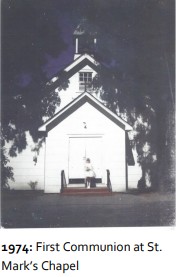 The building probably underwent extensive renovation before becoming a chapel. The current owner, Dr. Eric Salmonson, believes that the original general store was much smaller, as evidenced by portions of the original brick foundation in the basement. The two side “wings” under the sloping portions of the roof have only a crawl space under them, so it is assumed that they were additions to a long, narrow general store. The renovated chapel appears to be about twice the width of the original building.
In 1957, the Diocese of Rockville Centre was created by Pope Pius XII, and Bishop Walter P. Kellenberg became its first bishop. He officially designated both the Manorville and the Shoreham communities as “Missions” of St. John the Baptist. At that time, Shoreham was much smaller than it is today.
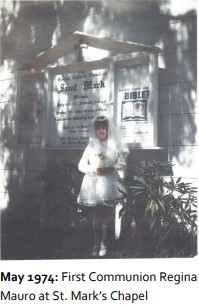 The Shoreham community began to grow rapidly. By the late sixties and early 70’s, Leisure Village and Leisure Knoll homes were being built. Brookhaven Lab and Grumman offered great employment opportunities. Shoreham Nuclear Plant became a landmark of contention, and the sleepy village of Shoreham spilled over Route 25A into the farm and sod lands in the area. The Catholic population basically worshipped at St. John the Baptist in Wading River. Its little white mission church in Shoreham was the center of Sunday Masses (Betty McAvoy, Our Voices 9/98).
Former Deacon Al Vigliotta remembered it well: Peg and I moved to Shoreham in May 1967. When we visited the chapel for the first time, we were quite surprised at its appearance. It looked like a summer church. The pews were in bad shape; the small organ had a nest of mice living in it. The main floor sagged as you walked down the aisle (Our Voices, 9/98).
The building that housed the mission church had its problems, but the size and spirit of the worshippers continued to grow. Father Fagan celebrated Mass at the Chapel at 11 A.M. each Sunday. The building held less than 100 people and in warm weather the chapel was often filled beyond capacity. The windows were opened wide and worshipers were outside and looking in through windows (Rey Mauro).
Spirit of Volunteerism
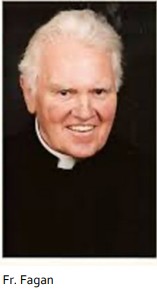 Most people who remember attending Mass at the chapel associate it with Father John Fagan. He describes his many years of serving the little mission chapel as follows: In 1959 the Bishop of Brooklyn assigned me to Little Flower House of Providence in Wading River. The day after I arrived in Wading River, I paid my respects to the pastor Father William Crowley. He asked me then to begin to say Mass at 10:00 at Shoreham…. So many wonderful things happened the following years. I remember how wonderful it was to meet the young couples with their children and the enthusiasm of the Shoreham people. The people make the parish. It was the people who at times scrub the floors, wash the windows, do all the linens and take care of the altar. They took the initiative regarding the needs of the chapel. On October 11, 1962, the second Vatican Council was opened and many things changed in our Sunday Liturgy. The altar was turned around and within 2 years we began to offer Mass in the English language. We had to search around for lectors (Our Voices, 10/98).
Several people fondly recalled how the spirit of volunteerism flourished in the little chapel. Al Vigliotta wrote: In his very special way, Father Fagan was the spirit of the chapel. He anticipated the needs of the church and asked for volunteers to oversee special jobs. People were assigned to open the church and prepare the altar. Altar boys were assigned and were faithful in attendance. Father Fagan did a great job in pulling loose ends together. Volunteers came forward whenever something needed to be done. I remember when the interior of the chapel needed to be painted. Enough volunteers helped to complete the job in two weekends. We found an old tabernacle in the chapel attic and in keeping with the new rules of Vatican Council II on liturgy, we set up the tabernacle on the side altar with a votive light. We also removed the altar rail at that time. All in all, the chapel was neat and clean and quite liturgical (Our Voices, 9/98).
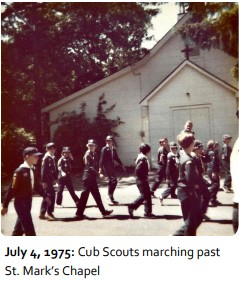 Edith Smith remembered a time vandals smashed the windows of the chapel and overturned the outdoor statues (Our Voices, 9/98). Because the building was broken into several times, it wasn’t safe to leave the sacred vessels there. Ben and Isabel Guidone used to carry them, the hosts and altar linens from St. John’s in Wading River to Shoreham every Sunday (Virginia Maher, Our Voices, 5/98).
Anne Kane, with Ben Guidone, the acting sexton, took care of the altar supplies and linens (Virginia Maher, Our Voices, 3/91). When there weren’t enough hosts or wine, it was Ben Guidone who drove over to St. John’s to pick up whatever was needed. On occasion, what was needed was a priest to say Mass! So Ben would drive to Greenport to pick up the visiting priest who came over on the Shelter Island ferry (Elizabeth Denlea, Our Voices, 5/90).
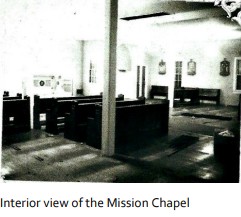 Volunteers would mow the grass, paint when needed, and attend to building maintenance. Parking was on the vacant strip of property that still exists on the northeast corner of Briarcliff and North Country. The owner of the house on the southwest corner allowed parking on his property (that is now fenced). Volunteers provided the music for all services (Rey Mauro).
The community of St. Mark’s was built on volunteerism. There were volunteers who ran water lines into the chapel and installed a sink, volunteers who painted the clapboard in the chapel, volunteers who made sure everything was ready for Mass on Sunday. Volunteers who cut the grass, who answered the phone in the rectory, and those who shoveled show. When we moved to the new church on Randall Road, there were volunteers who raised a huge tent for Parish Appreciation, volunteers who cooked in the rectory when the bishop came and volunteers who BBQed filet mignon at another time when the bishop came. When there was a snowstorm, a group of men would get a phone call from Dick Reda saying that Fr. Joe wants the new church shoveled and many men would show up. Got it done at no cost. (John Kowalski).
A Parish of our Own
By the early 70’s, Shoreham worshippers had outgrown their little chapel. During that same time period, Fr. Vitsas established a parish council at St. John the Baptist. Al Vigliotta was its president: We were anxious to discuss the possibility of the mission church in Shoreham becoming a parish of its own. The mission church was growing; many new families moved in, Leisure Village was underway. After many discussions at our parish council meetings, it was decided that we invite Bishop Kellenberg to one of our meetings with the sole purpose of presenting the pros and cons of establishing a parish in Shoreham. He was gracious enough to accept our invitation. The bishop eventually decided that St. Mark’s should be established (Al Vigliotta, Our Voices, 9/98).
On September 26, 1973, Bishop Kellenberg officially established the parish of St. Mark. Betty McAvoy described the boundaries as follows: Our territory runs from the Long Island Sound to the Long Island Expressway, and from William Floyd Parkway west to a bit beyond K-Mart (Our Voices, 9/98.)
Fr. John Fagan also remembered the formation of St. Mark’s Parish: Then as the years progressed there was a definite ground swell to have a parish of their own and some of the men worked very hard to make this happen. They formed a lay council and began to notify the Diocese of the desire to have a parish. Msgr. John McGann, the Secretary to Bishop Kellenberg, was very helpful and in fact he was personally very involved in purchasing the property on Randall Road in 1969 that would eventually become the Parish of St. Mark. I remember the call that I received in the autumn of 1973 from my classmate Fr. Raymond Tortora and he said “John, the bishop has asked me to establish a parish in Shoreham and its name will be St. Mark’s.” It was a very happy day (Our Voices, 10/98).
Our New Pastor and Associate
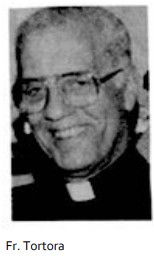 Fr. Tortora was installed as pastor at a ceremony presided over by the Rev. Andrew Gallagher, pastor of St. John the Baptist, Wading River. During the rite, parishioners presented Father Tortora with symbolic gifts. George Beatty Sr. gave him the keys to the tabernacle, to symbolize his pastoral authority; Albert C. Vigliotta presented the Gospel book, symbolizing the church’s teachings; Anne Cervini gave Father Tortora a stole, symbol of his priestly office…. Following the ceremony a reception was held for him and Father Kenny at the Shoreham Firehouse. The reception was attended by Bishop McGann, Vicar of Suffolk County, several other priests from the diocese, local non-Catholic clergy, and some 600 persons (The L.I. Catholic, 10/25/73)
The establishment of St. Mark’s was received with great joy, and we greeted Father Raymond Tortora and Father Robert Kenny with open hearts. To introduce our priests to the community, a reception was held in the Shoreham Fire House on a beautiful October Sunday afternoon with balloons and banners, punch and cupcakes. Neighboring clergy and local leaders joined the parishioners in celebration. Youngsters arrived on 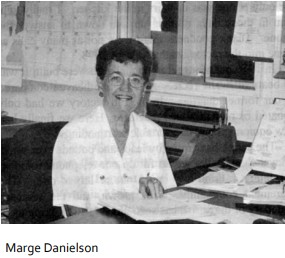 their bikes; toddlers climbed on the fire trucks leaving sticky fingerprints. Such a happy occasion! (Peggy Coughlin, Our Voices, 9/98).
At first, our new priests lived in the residence for clergy at Little Flower, but soon afterwards they established a rectory in a rented house at 26 John Street in Shoreham. Parishioners gathered to organize a shower and brought gifts of linens and household appliances. Marge Danielson became the parish secretary on November 3, 1973, thus beginning a forty-year career in that position. Her “office” was in the basement next to the washer and dryer.
Marge Danielson described her experience: My office was in the basement of the rectory, and the only phone was upstairs in the kitchen. I really kept slim in those days running up and 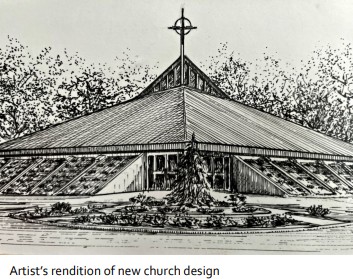 down to answer the phone. Thank goodness there were not as many calls back then. In 1976 our new rectory and church were built. It was so beautiful. The rectory seemed like heaven compared to our former quarters. In the old rectory we had only donated or reconditioned machines. Here we finally had new equipment and comfortable surroundings (Our Voices, 9/98).
After establishing a rectory at 28 John Street in Shoreham, Father Tortora set about creating a parish council for St. Mark’s. He and Father Kenny worked very closely with the council in the running of this new St. Mark’s. Of course one of the first topics for discussion was the building of the new church. The diocese has great sway in the building of a new church. After much interaction with the building department of the diocese, the bishop gave his approval. With many directives from the diocese, plans were set in motion. He and Fr. Kenny worked very closely with the council in the running of this new St. Mark’s (Al Vigliotta, Our Voices 9/98).
Designing Our New Church
Bishop Kellenberg had already purchased a ten-acre tract of land on what would become 105 Randall Road, the present site of St. Mark’s Church. George (Budge) Beatty, a young architect and parishioner from Shoreham Village, was commissioned to be the architect. Here is how Mr. Beatty described the concept behind his design: There is nothing grand or ostentatious about the structure. It has very simple lines. Our design was to tie the building into the land, which is very flat, by banking earth along the sides; the tent-like structure rises out of the ground in a symbolic gesture. The earth also cuts down on heat 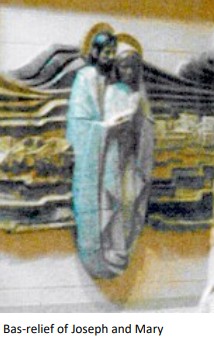 loss (George Beatty, Our Voices 9/98).
The church was built in the form of a tent to remind us that we are a Pilgrim People walking through the journey of life (Msgr. John Fagan, Our Voices, 11/98). The church won a Long Island Archi award that year for architectural excellence. According to George Beatty, the wood and stone building was designed in consultation with church officials. It reflected the new liturgical feeling promoted by Vatican II by grouping seats close to the altar and priest
The original worship space was half its current size. Imagine our current church being cut in half diagonally, with the original altar ending where the center posts now support the ceiling. The worship area could seat 485 people back then. The rear triangle housed two reconciliation rooms, restrooms, a kitchen and a parish center. Both church and parish center were all under one roof. The total cost was $850,000, which made St. Mark’s one of the lowest-cost structures built by the Diocese of Rockville Centre (Our Voices, 9/98).
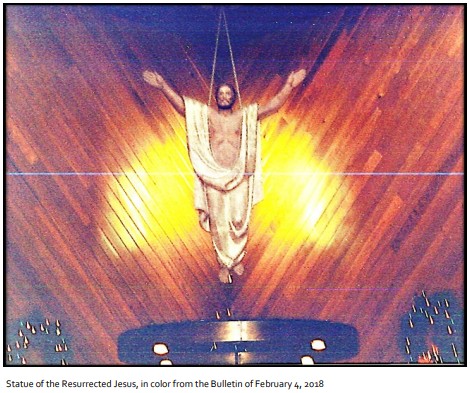
There is much symbolism evident in the planning and construction of the church. A reminder of the Blessed Trinity is felt in the triangular shape of the entire worship area and altar itself. Even the windows under the roof are three sided. Just as God appeared in a cloud of smoke above the Ark of the Covenant, so the tester or corona of light above the altar signifies God’s presence. Its sides have twelve ceramic candles representing the apostles with the blacked-out one for Judas. The pulpit is the same marble as the altar. The high-relief fish and cross remind us of Christ’s living word. A crucifix reminds us to accept our daily crosses as Christ asks. If we can do this, we can appreciate more fully the nine foot statue of the risen Christ suspended from the rear wall (Virginia Maher, Our Voices, 9/98). A bit of controversy developed over this large statue. There was much ado about the statue of the Risen Christ above the main altar. It didn’t please many people (Betty McEvoy, Our Voices, 9/98).
 To the right of the sanctuary, the sculpted figures of Joseph and Mary are models for Christian couples. Left of the altar is the baptistry. The blue-green ceramic waves signify baptismal water given in grace. The XP, of course, is Christ, while the dove represents the Holy Spirit. The stations of the cross are most realistic. Standing by the second station, you can imagine the weight of the cross. At the twelfth station you can almost feel the arms of Jesus outstretched in love (Virginia Maher, Our Voices, 9/98). Father Kenny asked Anne Kane to start an altar guild, for which he gave us list of chores which included dusting his beloved ceramics from Spain (Edith Smith, Our Voices, 9/98).
These and other art works were done by Raventos International of Barcelona, Spain (Virginia Maher, Our Voices, 9/98). George Beatty went to Spain with Fathers Tortora and Kenny to select statuary created by José Maria Gual (Betty McAvoy, Our Voices, 9/98).
It took time for the décor of the church to arrive from Spain. In the interim, we had pledge drives, card parties, wine tasting, linen sales, art sales, etc. One would assume that such fund raising, no matter how small, helped. In the course of working on some of those projects, rumors went about saying that some people objected to the church’s being built. Some others felt that it was larger than necessary for our small town. How mistaken they were! (Grace Dolce, Our Voices, 9/98).
The Move to our New Church
 On November 11, 1976, the little chapel was closed with a special ceremony by Fr. Tortora. A parade of parishioners, reciting the rosary, walked from North Country Road to the present church in a solemn procession. The Knights of Columbus color guard carried papal and American flags led by the Boy Scouts, the altar boys, priests and the people. The key to the chapel and the key to the new building were carried on velvet pillows. The original crucifix was brought along too, and now hangs above the main inside doors of the church (Betty McAvoy, Our Voices, 9/98).
Edith Smith also remembered that day: We attended the final service in the chapel where we sang and prayed, and Father Kenny delivered an inspiring homily. We marched along Randall Road to the new church, carrying the large crucifix which is now located above the inside entrance door and is used during Good Friday services. Coming into the new building and seeing the interior for the first time, we sang “Now Thank We All Our God,” which we all rendered with happy and grateful hearts” (Our Voices, 9/98).
The Selling of our Beloved Chapel
In the early 70’s, the little chapel at 47 North Country Road was sold. It was given a face lift and became a professional building. Half of it has housed the dental office of Dr. Ron Salmonson and his son Dr. Eric Salmonson. Ron Salmonson has written about this experience in his book, Ron’s Ramblings.
One Friday night just after the dentist office closed, Father Tortora walked in unscheduled. He was holding his jaw in excruciating pain. Father Tortora was severely allergic to all forms of Novocain. Dr. Salmonson was apprehensive about the possibility of complications developing, especially without anesthesia.
My assistant called the priest in and placed the bib. Father made the sign of the cross at least twice. I then gave Father Tortora nitrous oxide (laughing gas) to calm him down. To lighten the mood I asked, “Have you ever been called a High Priest before?” Later, Fr. Tortora disclosed, “I have a tough time going to the dentist. I feel guilty and don’t go unless there’s an emergency.” I retorted, “I never thought I’d see the day, I’d take confession and from a priest no less!”
I then drilled the tooth to see if it was salvageable. His bicuspid was indeed hopeless and had to be extracted. I don’t know who perspired more, Father or this dentist. A Supernatural Being surely intervened, as the tooth flew out! Father immediately said a Hail Mary.
 A week later, Father Tortora returned to thank me and stated that he wanted to have a private talk. I had no idea what he wanted to discuss. At the meeting he told me he had an epiphany. The church building could no longer accommodate its constituents. They were building a larger church, and the old New England type church would be for sale. He thought it would be a perfect location for my office, as he knew my practice was also outgrowing my home office. Fr. Tortora didn’t want the building destroyed (Our Voices, 9/2011).
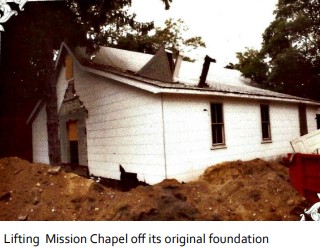
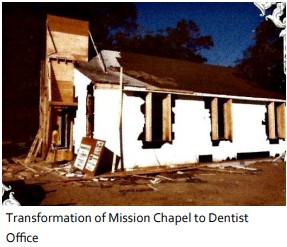
Dr. Salmonson mused: I of course, loved the concept of a Jewish guy from Brooklyn buying a church…. There were many problems changing the church into a dental office. We contracted a house mover to lift the building while a new foundation was poured. The church never even had a bathroom, only an outhouse. This building actually predated zoning codes! It took two years to complete the renovation. Finally, it was done – thanks to You Know Who.
“Upon This Rock I Will Build My Church” MT 16:18
The construction of St. Mark’s began in 1975 and the church was formally dedicated on December 12, 1976. Grace Dolce remembers attending that Mass: We had never attended a first Mass in a Catholic church before. It was a thrill, with Bishop Mc Gann, other church dignitaries and Fathers Kenny and Tortora celebrating that first Mass (Our Voices, 9/98). The parish grew by leaps and bounds. By its Silver Anniversary in 1998, there were about 2,600 families and almost 10,000 people of all ages who became members of St. Mark’s (Betty McAvoy, Our Voices, 9/98). To quote the famous line from Field of Dreams, “Build it and they will come!”
Click to enlarge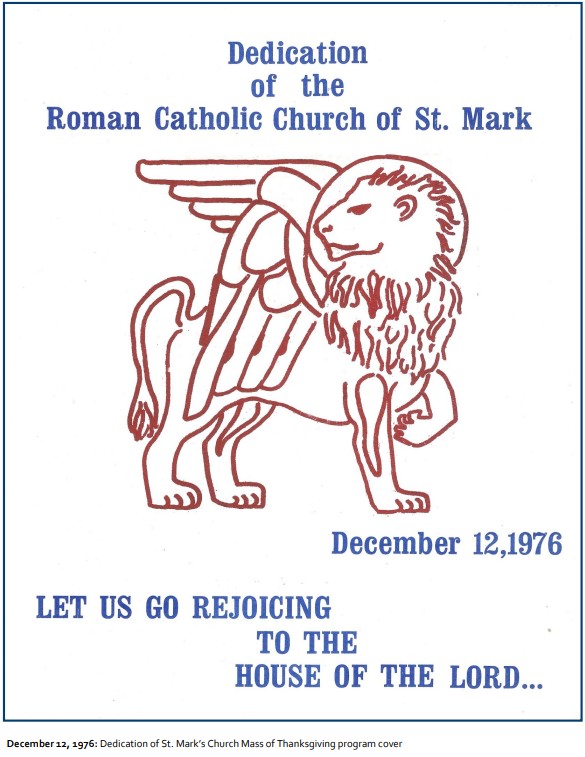 |
Click to enlarge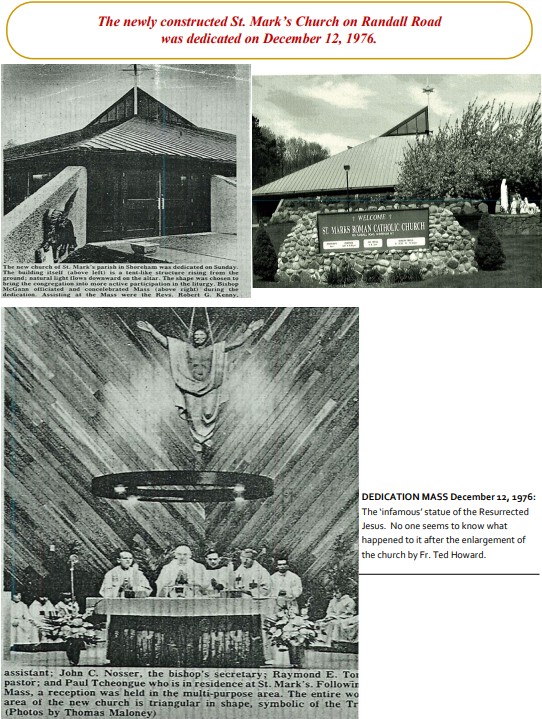 |
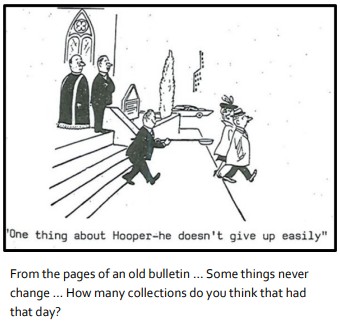
Fun FactIn the Spiritual and Financial Report of September 1, 1977 to August 31, 1978, Fr. Basel stated that the parish had 1,465 families registered and had three candidates for the Permanent Diaconate: Mr. Al Vigliotta, Mr. Don Donovan, and Mr. Bill Fullam. He also mentioned the assistance of the following priests: Fr. Fred Lerner, Fr. John Fagan, Fr. James Donelan, S.J., Fr. Raymond Kelly, M.M., Fr. George Gallagher, S.D.B., Fr. Joseph Mullen, O.F.M. Cap., Fr. Frank White, S.M.M. and Fr. James Manning, S.M.M. Note: the parish was also in a deficit of $6,600. Some things don’t change with the passing of time … |
 |
The 1990s and the Disco Ball
Shared by Jeanne Knudsen (Parishioner from 1986-present)
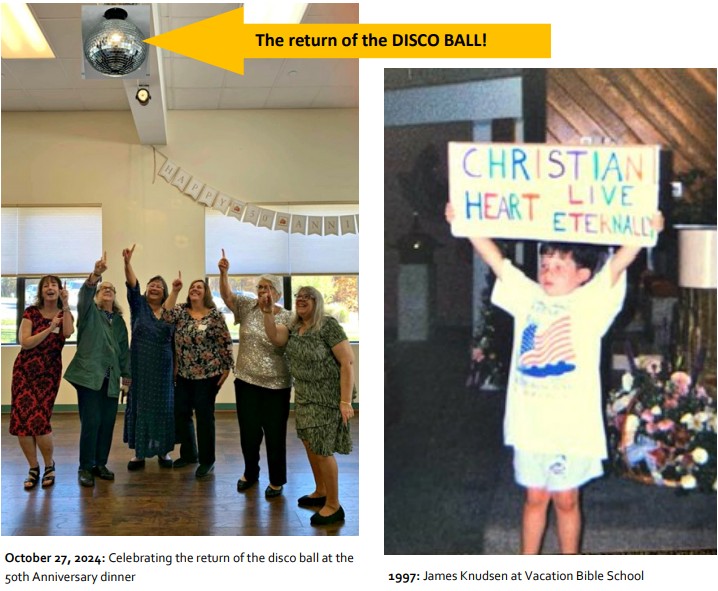
 The disco ball in the parish center was Fr. Ted Howard’s idea. He was the kind of priest who wanted people to form communities to share their faith, create meaningful relationships, and support each other. When the parish decided that the church needed to expand, Fr. Ted said the new parish center needed a disco ball to center the friendship and fun.
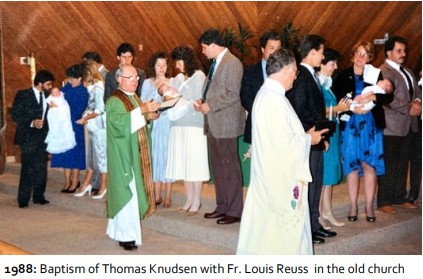
We moved to Ridge in 1986. On a cold December Sunday, we walked into St. Mark’s and were greeted by Fr. Joe Basel. He recognized us as new parishioners and immediately introduced himself and asked our names. When we came to Mass the next weekend, he greeted us by name. From that moment on we knew we were in a warm and welcoming parish. Sadly, fifteen months later, Fr. Basel died suddenly while power walking on Randall Road and our parish managed for a time with the care of Fr. Ron Richardson, administrator, and by visiting priests. When Fr. Ted Howard arrived and became our pastor, he ushered in a time of growth and change for the parish. Our family helped with that growth as we had four boys baptized in the parish starting with Thomas in 1988. As premature babies, Jimmy and John were baptized at St. Charles (Jim by Fr. Larry Duncklee, John by a Catholic nurse) and received a blessing from Fr. Bill McCarthy. Mark was baptized by Fr. Bill in 1996.
Fr. Ted and Fr. Bill said six Masses a weekend; seven if you count the Saturday daily Mass (5 and 7pm on Saturday, 8, 9:30, 11am and 12:30pm on Sunday). As a family, we sat behind the Contemporary Ensemble (led by John Aloisio), hoping their music and some Cheerios would hold our young boys’ attention. In the old church, the music ministry was on the right side of the church near the doors to the parish center which was, essentially, the back third of the building. (The reason our crucifix is so high is that it hung directly over the altar in the old church.) From that vantage point, we could also see the altar servers who sat on the right of the altar which had candles representing the twelve apostles (with one non lit for Judas).
 During Fr. Ted’s time as pastor, the parish grew. People were moving east to Shoreham and Ridge and the surrounding area, and, like my family, they found their way to our church on Randall Road. During this time, the church was reconfigured into a larger worship space and the separate parish center was built. This physical expansion required three financial campaigns and parishioners were very generous in support of the construction project. First, the parish center was built between the church and the rectory. Mass was said in the parish center while the church was gutted and reconfigured. While at Mass in the center, my sons would peek a bit through the wood and windows to see the progress in the church. Once the church was finished and blessed, Masses resumed in the new, larger worship space. The Music Ministry moved to the left of the altar; so did our family.
 Once in the new church, the ministry of altar serving grew to eventually include girls as servers. Each Mass had at least two altar servers to assist the priests with the liturgies. Fr. Bill usually led the altar server training, especially the procession with the cross. At one 8 am Mass, the heavy cross almost got the best of my son John, who, as a small third grader, could not hold the top-heavy crucifix. As the cross fell back about to crash into the new wall, Fr. Ted did a quick grab to straighten the cross (and John).
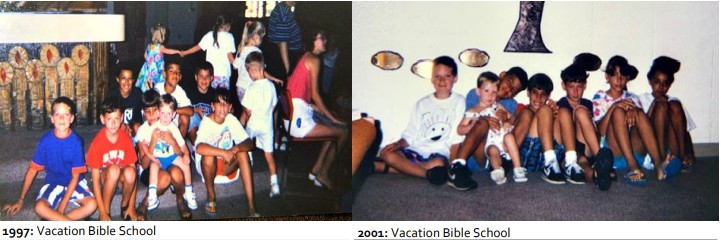
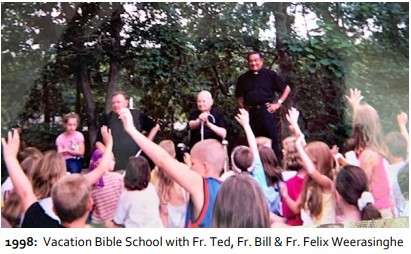
There were many new initiatives during the 1990s and 2000s at St. Mark’s. Fr. Ted introduced “Religion and People” more commonly referred to as RAP. The teenagers of the parish would meet weekly with adults who welcomed the kids into their homes, guided them in 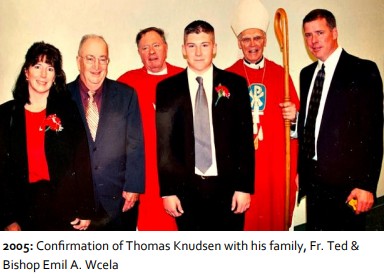 their faith, and listened to them explain problems and concerns. We also had ACTS or Adults Coming Together which helped create friendships through faith for adults in our community. We had vacation bible school (VBS) for a week every summer with themes like “Let Your Light Shine” and “Summer with the Saints.” We had a lot of children participate, they had fun, learned more about our faith, and the week always ended with a Mass (outside if the weather was nice). We used our new center for the Family Advent Night and Shrove Tuesday (or pancake night as the kids called it). The Baker and Taddeo families were often at the pancake griddle. And we had many dances under that disco ball, bubbling and bonding as a parish family.
Fr. Ted was a big sports fan, and no Mass was complete without a shoutout to either the Mets (his favorite), the Yankees, or, in the fall, the Giants and Jets. My sons loved the sports references especially during the “Subway Series” of 2000 when, much to Fr. Ted’s dismay and our son James’ delight, the Yankees beat the Mets in 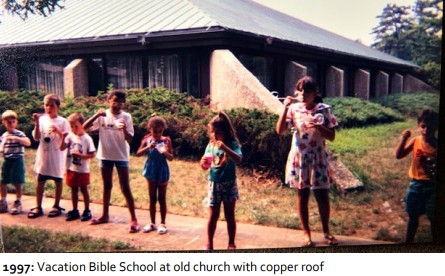 five games to win the World Series.
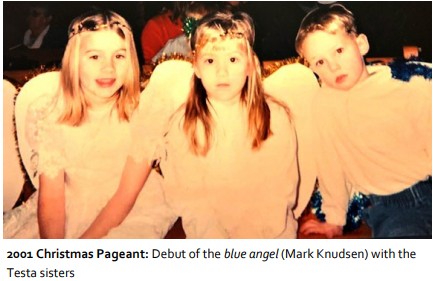
The Christmas pageant that started in the old center with children simply reading the nativity story (Testa, Fellrath, Hein, and Knudsen families) changed dramatically during this time. Once the new church was ready, the angels, shepherds, lambs, village people, and Holy Family were able to recreate the nativity (complete with star) using the altar as the centerpiece of the sacred story. The first time the pageant was in the new church, my youngest son Mark took some convincing to participate and was finally onboard as long as he could be a “blue angel’ complete with blue wings and matching halo. Under the loving leadership of Mrs. Pat Fellrath, the Christmas Pageant has continued to offer our children a fun way to learn about the true meaning of Christmas.
 Christmas also had a bit of friendly competition as Fr. Ted enjoyed colored lights on the Christmas trees and Fr. Bill advocated for white lights. Usually, the type of lights alternated by year, but I do remember one year where the altar decorations included one tree with white lights and one with all colors. Christmas was also not complete without Fr. Ed Muhs giving small stockings to babies who attended Mass during Advent. He would call parents with the baby up to the altar, give the young family a special blessing, then give the baby a small stocking. On Christmas Eve, Fr. Ed would sing “Silent Night” in German in a special duet with Mrs. Pat Johnson; that song brought such joy to our parish family on that special night.
It was during this time (early 2000s) that the parish changed the age at which our young people received the Sacrament of 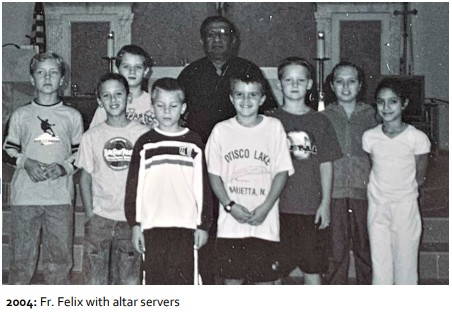 Confirmation. Prior to the change, teens worked toward the sacrament for two years and received Confirmation in spring of their senior year. As a Confirmation teacher, I saw how the older teens struggled to manage the weekly CCD meetings, their academics (especially Regents prep), and jobs. A few families approached Fr. Ted with the suggestion of lowering the age to better match the ages when children received Confirmation in our neighboring parishes, specifically St. Anthony’s and St. John’s. As pastor, he took our suggestion under advisement, did some research with Mrs. Lynn Fein, and eventually changed our Confirmation to fall of ninth grade. After receiving Confirmation, the young people joined a RAP group to continue to grow their faith. My oldest son, Thomas, participated in RAP all through high school with Mrs. Eileen Morello who led a wonderful group of young people through the challenges of high school.
I was happy to see the disco ball dusted off and hung in the parish center in honor of the parish’s fiftieth anniversary. Although it might seem a funny symbol for a church, for me, the disco ball reflects the changes that occurred in St. Mark’s during our expansion of the 1990s and 2000s. That disco ball shines a light on the growth of faith, families, and relationships that shaped St. Mark’s. May the Lord and that disco ball continue to shine on our parish.
Click to enlarge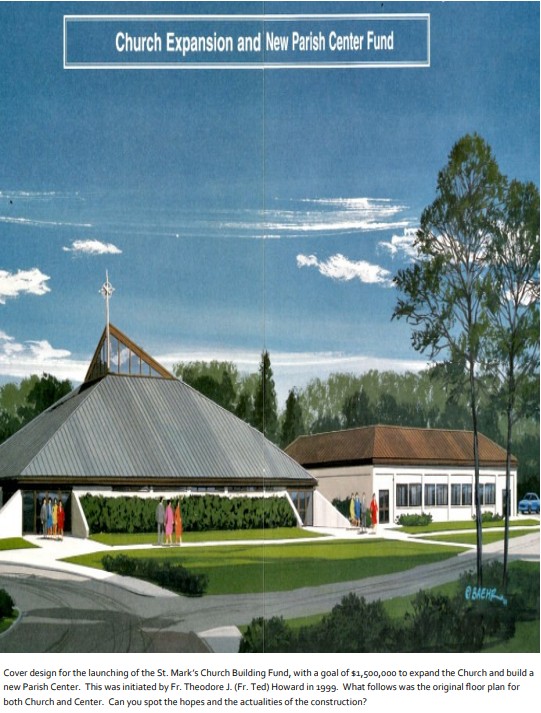 |
Click to enlarge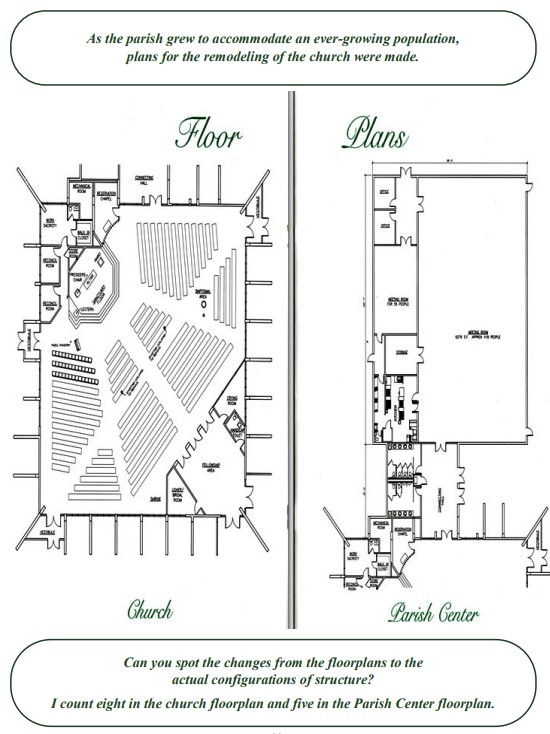 |
Click to enlarge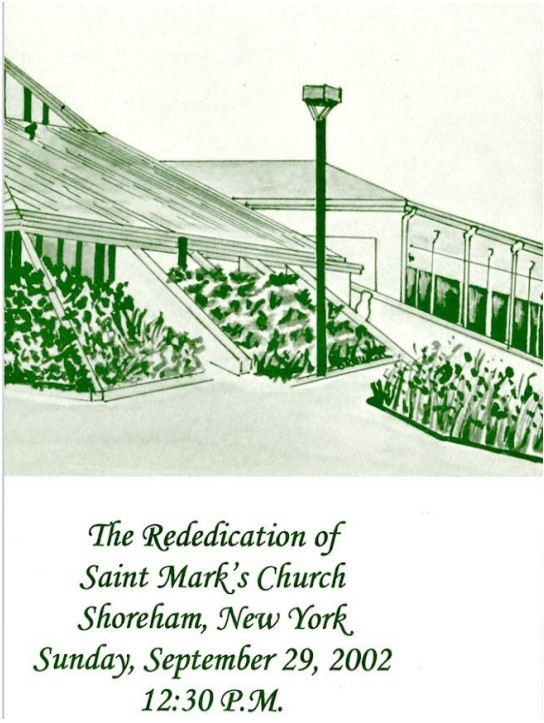 |
Click to enlarge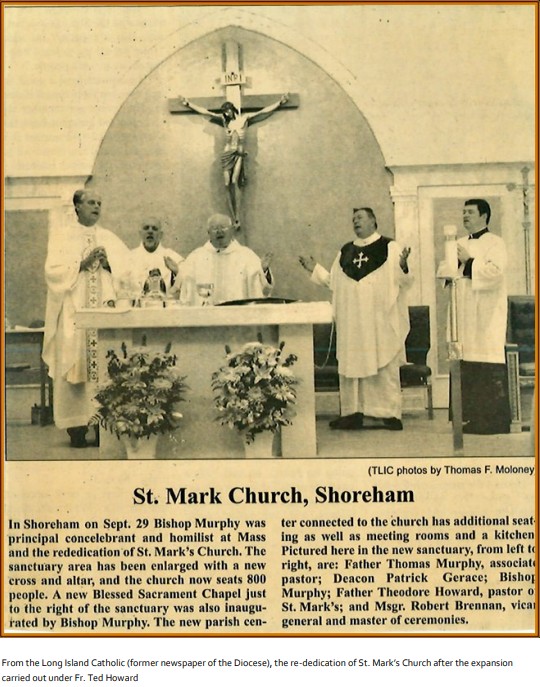 |
Click to enlarge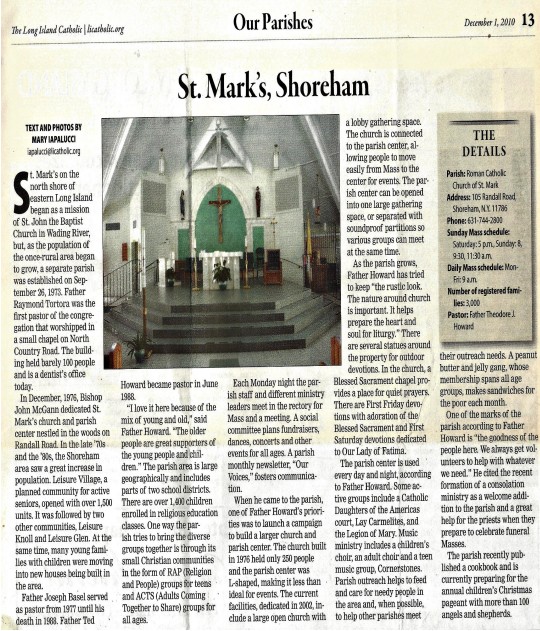 |
The Challenge of the Pandemic
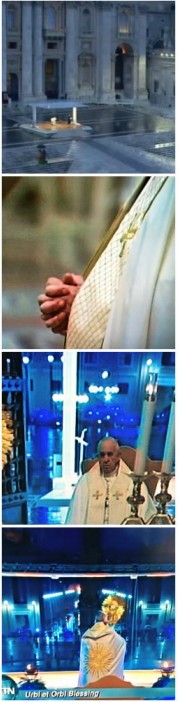 During the deadliest months of the coronavirus pandemic, when many most needed their faith communities, houses of worship including the Vatican and St. Mark’s were either closed or operating with limits on attendance. The solace of grieving with family and friends, the comfort of the communal rituals of prayer and the joys of ceremonies celebrating births and weddings were missing.
The final weekend Mass on Sunday March 15, 2020, the Feast of the Good Shepherd, was like a funeral. Beginning the following day, March 16, 2020 at 3:00pm, all Masses (weekday and weekend), liturgies, devotions, meetings, and non essential activities in our parish were suspended. Holy Week of 2020 was the first in history without the public. Celebrating all the rites before an empty church was an experience one could never have imagined. It was not until June 14, 2020 on the Feast of Corpus Christi that our parish re-opened on a limited basis. In retrospect, it is consoling that this most fearful and desolate time was bookended by two hope-filled feasts … The Lord is my Shepherd, I shall not want … This is My Body, Do this in Remembrance of Me.
On Friday, March 27, 2020 Pope Francis presided over a moment of prayer outside of St. Peter's Basilica for those suffering from the coronavirus pandemic. Urbi et Orbi means “To the City [of Rome] and to the World.” It is a special apostolic blessing given by the pope from the balcony of St. Peter’s Basilica every year on Easter Sunday, Christmas, and other special occasions. “We want to respond to the pandemic of the virus with the universality of prayer, compassion, and tenderness. Let us stay united,” Pope Francis said.
The service came in an extraordinary setting. He prayed before an empty Square from the sagrato of St. Peter’s Basilica, the platform at the top of the steps immediately in front of the façade of the church. The Salus Populi Romani icon and the crucifix of St. Marcellus were placed in front of the central door of St. Peter’s Basilica. [Marcus Claudius Marcellus (42–23 BC) was the eldest son of Gaius Claudius Marcellus and Octavia Minor, sister of Augustus (then known as Octavian). An illness was spreading in Rome which afflicted both Augustus and Marcellus. Augustus caught it earlier in the year, while Marcellus caught it later, after the emperor had already recovered. The illness proved fatal and killed Marcellus at Baiae, in Campania, Italy. He would be the first member of the imperial family whose ashes were placed in the Mausoleum of Augustus.] The Blessed Sacrament was exposed on the altar in the atrium of the Vatican Basilica.
The absence of normalcy and desolation during the pandemic took a deep physical, spiritual and emotional toll — not only on our parish family but also on our clergy who struggled to serve the faithful from afar.
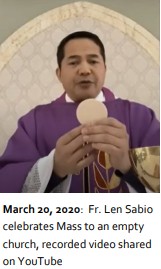 Congregants’ needs were unending. The ability of our clergy to respond was at times limited by the virus, distance and the number of hours in a day. Our clergy were challenged to be creative and employed modern technology to pray with congregants safely.
Even though Covid brought so much death and so much grief and so much sickness, it has also given us some gifts. The gifts of reimagining worship and of recognizing that the spirit of God is within and that we’re connected by our humanity, by our breath, and not only by a pew in a church. But it meant a new opportunity to rediscover our faith because of all the limitations, and the problems compelled believers to understand that faith was something even deeper. And we had much more time for prayer and a very deep need to pray.
We talk about the body of Christ, and that has everything to do with physical presence, not just online presence. What Christianity offers to the world is incarnation in flesh and the importance of presence. You can’t throw water at a screen and baptize a baby. And you can’t have communion which is, in part, the gathering together of body parts. What Christianity says is, that no matter what happens, there is something essential about touch, physicality and intimacy.
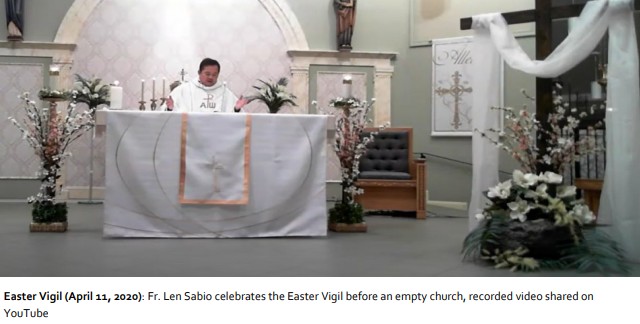
It became very clear early on that Covid would stick with us for a long time. Prayer sustained us because as a matter of faith we acknowledge our complete reliance on God. And in a sense, prayer is acknowledging that we are not in control. Covid showed the world that we are not in control. But nothing substitutes for gathering with people, in the flesh.
It took a few years for us to return to what we have come to call a new normal. The faith of the people is stronger, and we experienced a rebirth or resurrection of sorts. Having lived without, people yearned for and understood more deeply the value of the Eucharist. We belong to a family, to a community, that is one body, always connected. There is no doubt that the pandemic has altered our lives and imprinted a lasting memory.
Our 50th Anniversary Year
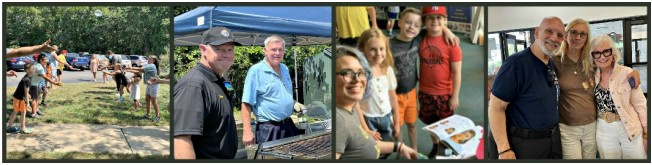
Celebrating a parish anniversary is a significant event, marking not just years of existence but also the impact and growth of a spiritual community. It’s a time for reflection, gratitude, and looking forward to the future with hope. So … what did we do to make this celebration or our 50th anniversary memorable?
Our anniversary year began with a pre-event, a parish BBQ on a perfect summer afternoon on August 6th, 2023. Reminiscent of family picnics from the past, our BBQ was enjoyed by the young and the young at heart and is planned to be an annual summer event.
As we moved into the month of September, our family settled into the normal rhythm of parish life. With the return of our choirs, our weekend liturgies were once again filled with joyful voices. Our children were welcomed back to faith formation to continue their journey of growing in knowledge and love of our faith. With open hearts and arms, we welcomed Msgr. Joseph Staudt (Fr. Joe), a long-time friend of Fr. Jim, to our parish family to assist with weekend Masses, funerals and other responsibilities when possible.
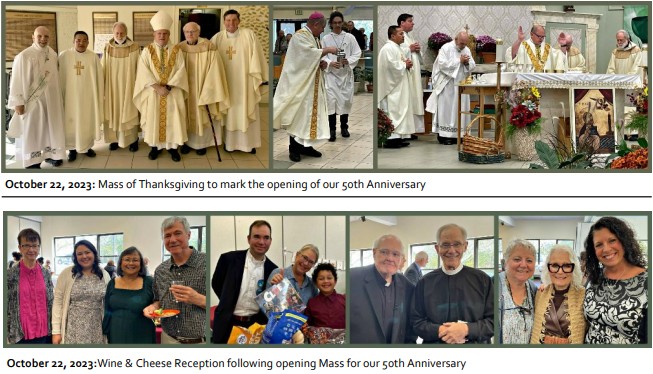
While it seemed like most other years, there was a hint of excitement bubbling. In the bulletin for September 17, 2023, Fr. Jim announced that our anniversary year would officially open with a Mass of Thanksgiving to be celebrated at 11:45am on October 22, 2023, by Bishop Coyle, Vicar for Suffolk County, followed by a Wine and Cheese repast in Fr. Ted Howard Hall. And so began our 50th Anniversary year with our parish family, friends, current and former clergy gathered around the Eucharistic table. A sense of joy and hope spread as we began to experience a renewal of parish family life.
 Advent marked the beginning of a new liturgical year. While we waited with expectation and hope for Christmas, Advent not only offered us the Christmas Pageant, but the return of Lessons and Carols. In addition, the children from our Faith Formation program added joy to our homebound parishioners with creative Christmas cards delivered by our Eucharistic Ministers.
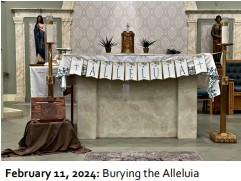
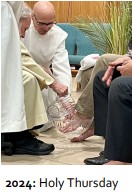
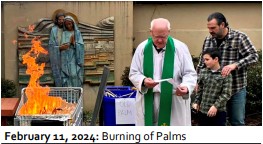 Following his pastoral style of transparency and inclusion, Fr. Jim established a Liturgy Committee to assist in planning liturgical services that would engage the parish family in prayer and song. Two of the first liturgical events planned by the committee were Burying the Alleluia before Lent and the Burning of Palms for Ash Wednesday. Both services, rich in tradition, offered a visual reminder of the meaning of the season of Lent.
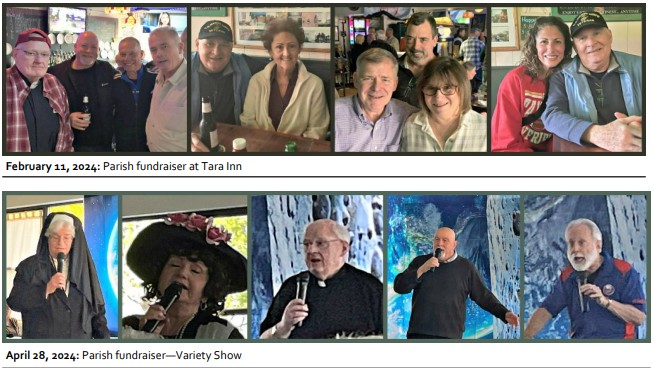
Our anniversary year was marked by two unique and enjoyable Parish fundraising events. The first was held on February 11 at Tara Inn, an Irish pub in Port Jefferson, and the second, a Variety Show, was held on April 28 in the parish center. Once the rumor that both Fr. Jim and Fr. Joe would perform in the Variety Show spread, ticket sales increased quickly. It was a sold-out crowd, and the singing duo did not disappoint. Fr. Jim, accompanied by Keith O’Brien, sang Four Green Fields, a well-known Irish ballad and Fr. Joe sang a song by Billy Joel, I Love You Just the Way You Are. Fr. Joe shared that this song should remind us that our beloved Father embraces us “just the way you are.”
 We were soon into the month of May in which we shared with the families of our First Communicants in welcoming them to the Table of the Lord for the first time. There is always room for one more at our table. As always, the end of our Easter season was marked with the Feast of Pentecost. But this year our Pentecost celebration was quite unique. Fr. Jim invited parishioners to read one of the Readings in their native language including Italian, Spanish, Lithuanian and Tagalog. Fluent in Spanish, Fr. Joe proclaimed the Gospel. In addition, a Pentecost fire of sorts was lit to remind us of the presence of the Holy Spirit. Adding to the celebration, our First Communicants were invited to participate in the Crowning of Mary service to honor our Blessed Mother in the month of May.
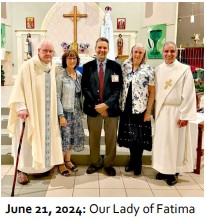
 On June 21, the Pilgrim Virgin Statue of Our Lady of Fatima was hosted by Our Lady of Fatima Praesidium at our parish. The Pilgrim Virgin Statue is a beautiful, hand-carved image of Our Lady of Fatima, sculpted by Jose Thedim's son. The purpose of the Pilgrim Virgin Statue Tour for Peace is to introduce people to Our Lady’s message of hope, peace and salvation, and to bring the graces of Fatima to those many millions of people who may not otherwise have the opportunity to make a pilgrimage to Fatima itself.
In June, planning for our 50th Anniversary began in earnest. Fr. Jim formed two committees, one to plan the anniversary dinner and the other to prepare the anniversary journal and he himself went about designing a flag to memorialize the 50th anniversary.
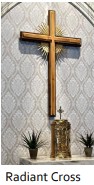
Have you noticed? Over the past year our parish campus has undergone much needed renovations and repairs. In addition to a new roof, repairs and painting, we also have a new cross (Radiant Cross or Cross of Light) and Paschal Candle stand. The statues of Mary and Joseph have descended from their lofty perches and now grace our sanctuary on newly designed stands. All of these were carefully handcrafted by Chris Geraghty. The Parish Office, Rectory and bas-relief sculptures that adorn the outside of our church have also undergone a transformation as well as our landscaping.
Amidst the joyful celebrations of our liturgical year and the special events for our 50th anniversary, there were ordinary days and events that are part of parish life. Our parish family welcomed the newly baptized and bid farewell to our beloved parishioners whose life on earth has ended.
The Summer months quickly passed, and Fall settled in. We had the joy of welcoming Deacon Mark to our parish family and welcoming our children to a new school year with a special Blessing of the Backpacks. Our Level 6 children and their parents and/or grandparents participated in a Bible Ceremony during which the children received their Bibles from their parents. Training for new Altar servers began with Fr. Jim assisted by Chris Silva who has more than 11 years of experience as an altar server.
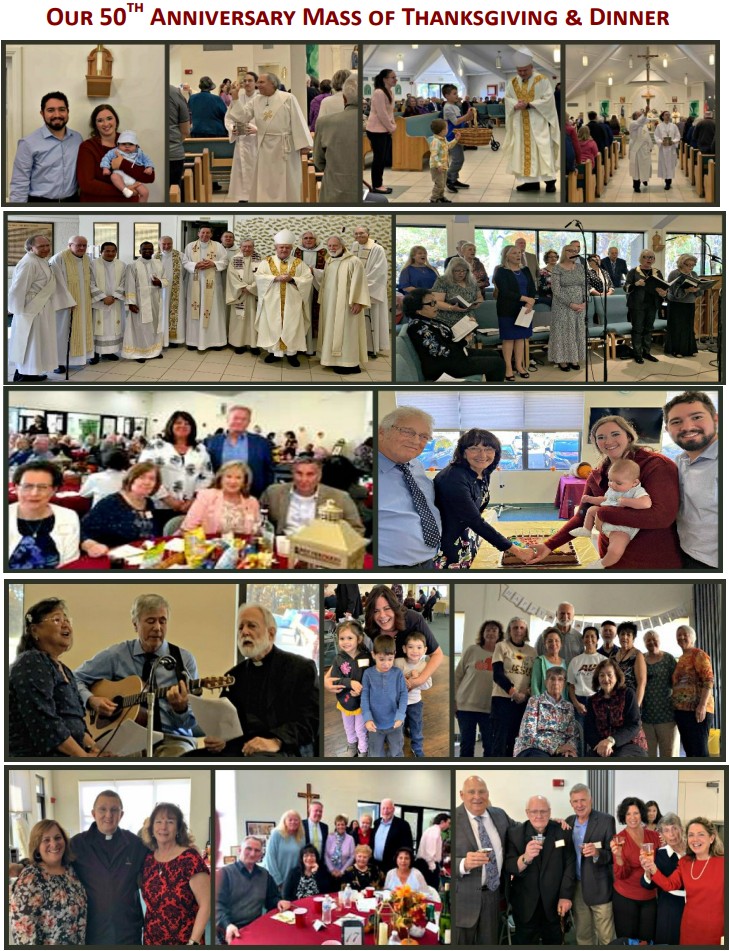
With the anniversary celebration quickly approaching, excitement began to grow. And then the day arrived… Sunday, October 27, 2024, a beautiful Fall day on which more than 240 gathered to celebrate our 50th anniversary. Bishop Coyle returned to preside at the closing Mass of Thanksgiving and was joined by former priests of the parish. The Mass was followed by an elegant dinner and of course, the return of the disco ball.
Our anniversary year was memorable, marked by the ordinary and the extraordinary. We give thanks for the gift of our gracious God’s presence in our lives, yesterday, today and tomorrow.
Our Clergy & Staff
Our Clergy
Rev. Raymond E. Tortora, Founding Pastor (9/26/73-1977)
Rev. Robert G. Kenny, Co-Founder Associate Pastor (1973-1977)
Weekend Clergy
Rev. Msgr. John T. Fagan (1959—2002)
 Rev. Joseph S. (Fr. Joe) Basel, Second Pastor (12/15/1977-3/7/1988)
Rev. Michael P. Flynn, Associate Pastor (1978-1979)
Rev. Michael (Fr. Mike) Vetrano, Associate Pastor (1979-1983)
Rev. Andrew G. (Fr. Andy) Nirrengarten, Associate Pastor (1982)
Rev. Lawrence (Fr. Larry) Duncklee, Associate Pastor (1983-1988)
Seminarians
Mr. Warren Gress (1978)
Mr. Harold Nichols (1983)
Weekend/Summer Clergy
Rev. Martin Feeney (1985-1990)
Permanent Deacons
Rev. Mr. Albert (Deacon Al) Vigliotta (1978-1999)
Rev. Mr. Donald (Deacon Don) Donovan (1981-1998)
Rev. Mr. William (Deacon Bill) Fullam (1982)
Rev. Ronald A. (Fr. Ron) Richardson, Administrator (3/12/1988-6/15/1988)
Rev. Theodore J. (Fr. Ted) Howard, Third Pastor (6/26/1988-6/24/2012)
Rev. George M. Schmitt, Associate Pastor (1988-1989)
Rev. William E. (Fr. Bill) McCarthy, Associate Pastor (1989-2002)
Rev. Thomas F. (Fr. Tom) Murphy, Associate Pastor (2002-2003)
Rev. Felix Weerasinghe, Associate Pastor (2003-2007)
Rev. Thomas Rajamanicam, Associate Pastor (2004-2006)
Rev. Cyril Obi Bayim, Associate Pastor (2006-2007)
Rev. Francis (Fr. Frank) Gnanasegaram, Associate Pastor (2007-2010)
Rev. Michael Mozia, Associate Pastor (2007-2010)
Rev. Ivan Gonzalez, Associate Pastor (2008-2012)
Rev. Christopher Deh, Associate Pastor (2010-2012)
 Weekend/Summer Clergy
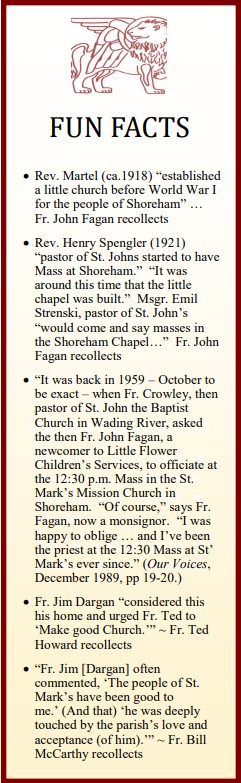
Rev. Fred Lerner
Rev. Raymond Kelly
Rev. Thomas F. Ryan (1980-1992)
Rev. John Sullivan (1987)
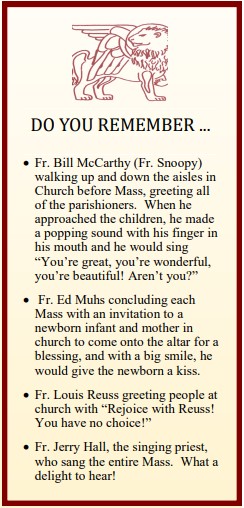
Rev. Edward (Fr. Ed) Muhs (1988-2002)
Rev. James (Fr. Jim) Dargan (1988-1991)
Rev. John O’Sullivan (1989)
Rev. Francis Kevin Drolet (1989-1992)
Rev. Louis Garaventa (1990)
Rev. Frederic Harrer (1990-1995)
Rev. Louis Reuss (1990-1999)
Rev. Msgr. Cesar Gatela (1992)
Rev. Jerome M. (Fr. Jerry) Hall (1991-1994)
Rev. Paul Dahm (2007)
Rev. Charles Okonkwo (2007)
Permanent Deacons
Rev. Mr. Patrick (Deacon Pat) Gerace (1998-10/27/26)
Rev. Mr. Anthony (Deacon Tony) Chamberlain (2003-2008)
Rev. Msgr. Jeffery (Fr. Jeff) Madley, Fourth Pastor (7/8/2012-6/30/2019)
Rev. William Scott Daniels, Associate Pastor (2013-1014)
Rev. Alloysious Melly, Associate Pastor (2014-2016)
Rev. Thomas (Fr. Tom) Tuite, Associate Pastor (2016-2022)
Permanent Deacon
Rev. Mr. Gino Aceto (2016-2024)
Rev. Lennard (Fr. Len) Sabio, Administrator (7/7/2019-8/23/20)
Rev. James Calledo, Associate Pastor (2020-2023)
Rev. Msgr. Francis (Fr. Frank) Schneider, Fifth Pastor (9/6/20-1/11/23)
Rev. James-Patrick (Fr. Jim) Mannion, Administrator (1/11/23-present)
Weekend/Summer Clergy
Rev. Msgr. Joseph (Fr. Joe) Staudt, Assisting Clergy (2023-present)
Rev. Joseph Francis, Assisting Clergy (2023-present)
Rev. Henry Vas, Assisting Clergy (2023-present)
Rev. Luis Ezeilo, Assisting Clergy (2024-present)
Permanent Deacon
Rev. Mr. Mark Herrmann (2024-present)
 Our Pastoral Staff
Adult ACTS Directors
Rev. Mr. Pat Gerace (2004-present)
Mrs. Rosemary Giuliano (2004-2006)
Mrs. Jane Fagan (2008-present)
Business/Financial Manager/Bookkeeper
Mrs. Rosemary Kowalski (1977-1981)
Mr. Michael Annarella (1993-2003)
Dr. Jeffrey Pedersen (2021-2022)
Mrs. Lindsay Finter (2024-present)
Community Ministries
Mrs. Eileen Morello (1997-2001)
Confraternity of Christian Doctrine (CCD)/Religious Education/Faith Formation
Mrs. Peggy Coughlin, CCD Coordinator (ca 1960-1966)
Mr. Timothy & Mrs. Bernice O’Sullivan, CCD Coordinators (1966-1973)
Sr. Eileen McKenna, CCD Coordinator (1973-1977)
Sr. Virginia Dunne, D.W., Religious Education Coordinator (1977-1998)
Mrs. Evelyn Pepitone, Secretary (1987-1999)
Mrs. Lynn Fein, Faith Formation Coordinator (1998-present)
Mrs. Judy Holohan, Secretary (1999-2000)
Mrs. Marie Rhinehardt, Secretary (2001-2004)
Human Concerns/Parish Outreach
Sr. Joan Lenihan, O.P., Human Concerns Coordinator (1978-1981)
Sr. Barbara Petty, S.C. Halifax, Parish Outreach Coordinator (1981-1989)
Sr. Joan Quinlan, O.P., Parish Outreach Coordinator (1989-2010)
Mrs. Jane Fagan, Parish Outreach Coordinator (2010-present)
Liturgy Coordinator
Sr. Marie Brescia, C.S. J. (1981-1983)
 Music Coordinator/Director of Liturgical Music
Mr. Bart Gallagher [Banjo Band] (ca 1973-1975)
Mrs. Jean Sutter [Folk Group] (1976-1981)
Mr. Dan Grable (1981-1990)
Mr. Robert Kirchner (1990-1995)
Mrs. Carrie Logan (1995-present)
Pro-Life Director
Sr. Joan Quinlan, O.P. (12/1999-2010)
Mr. John McNamara (12/1999- 2020)
Social Committee
Mrs. Betty Pizza (2014-2018)
Mrs. Nora Wood (2004-2010)
Mr. Henry & Mrs. Marie DiPrete (2004-2010)
Sports Coordinator
Mr. Jack Friel (1978-1979)
Mr. Ed O’Donnell (1979-1980)
Mr. John Rager (1980-1981)
Mr. John Coster (1981-1984)
Mr. Hector Torres (1984-1988)
Mr. Mike Secko (1988-2007)
Teenage Rap/Youth Ministry Director
Mrs. Lynn Fein (1998-2020)
Mr. John McNamara (1979-2020)
Welcome Wagon/Hospitality Coordinator
Mrs. Joan Vander Putten (2000-2004)
Mrs. Ellen Masterson (2004-2011)
Mrs. Nora Wood (2004-2010)
Mrs. Sue Kennedy (2011-2014)
Our Support Staff
 Facilities Manager/Building and Grounds/Custodian
Mr. William Danielsen (1975-1990)
Mr. Jim Lindsay (2004-2021)
Mr. Jimmy Johnson (2021-2022)
Mr. Michael Oliva (2024-present)
Mr. William Castillo (2024-present)
Parish Secretary/Office Manager
Mrs. Marge Danielsen (1973-2012)
Mrs. Susan Schena (2012-2021)
Mrs. Sue Kozakiewicz (2020-2022)
Mrs. Marianne Brandt (2020-present)
Sexton/Sacristan
Mr. Benjamin Guidone (ca 1970-1976)
Mrs. Anne Kane (ca 1970-1976)
Mr. Joseph Magnavita (1976-1990)
Mr. Joseph Inguanta (1990-2001)
Mr. Patrick Santulli (1990-1996)
Mr. Charles Haberkorn (1997-2002)
Mrs. Angela D’Ambrosio (1999-2002)
Mr. Walter Torpey (2001)
Mrs. Amy Aviles (2002-2003)
Mrs. Rosemary Guiliano (2003)
Joe, Ron & Al (2009) Mr. Gary Duryee (2018-2020)
Mrs. Alice Vozzo (2021-present)